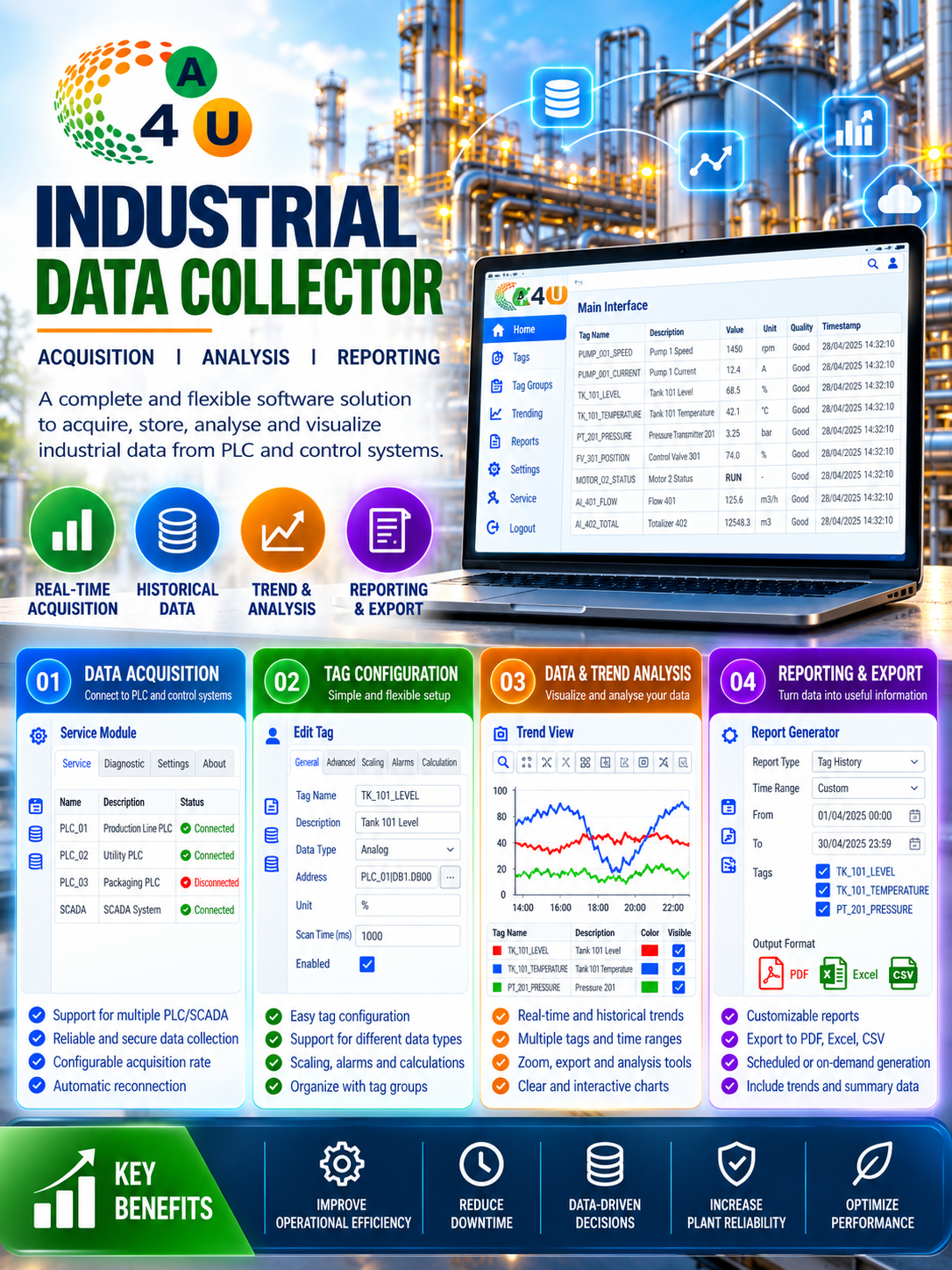
Turn industrial data into actionable information.
A4U IDA is an Industrial Data Acquisition & Analyzer platform designed to acquire, organize, store and analyze process data coming from PLCs and industrial control systems. It provides a centralized environment where production and engineering teams can monitor real-time information, access historical data, analyze trends and generate reports. The software communicates with the automation system through an Ethernet interface and provides a structured graphical environment for managing industrial information. What can IDA be used for? IDA creates a bridge between automation data and operational analysis. According to the software documentation, its core functions include real-time process-data acquisition, historical recording and storage, trend monitoring, reporting and data export, together with support for fault diagnosis and performance optimization. Typical applications include: Real-time data acquisition – collect process variables directly from PLC and control systems. Historical data collection – record process information for later investigation and comparison. Trend analysis – visualize process behaviour over time and compare variables. Tag management – structure the information acquired from the automation system into an organized dataset. Reporting & export – transform collected information into reports or exportable datasets. Diagnostics & troubleshooting – use historical and current information to investigate abnormal machine or process behaviour. Configuration management – import and export Tags, Tag Groups and Calculation Groups in JSON format, simplifying configuration transfer and reuse. Continuous background acquisition – the IDA Service Module operates as a Windows service and can continuously log PLC data independently of the main user interface. Its diagnostic log also supports troubleshooting of the acquisition process. Business advantages The commercial value of IDA is not simply collecting more data, but making existing industrial data easier to access and use. Better process visibility. Production and engineering teams can work with real-time and historical information from a centralized application rather than relying exclusively on instantaneous PLC/HMI values. Faster troubleshooting. Historical information and trends provide engineers with additional context when investigating faults, intermittent events or unexpected process behaviour. Fault diagnosis and performance optimization are explicitly identified among IDA's intended functions. From data to continuous improvement. Stored production information can be compared over time to support process analysis and identify opportunities for optimization. Structured industrial information. Tags and groups make large quantities of automation data easier to organize and manage, while import/export functions facilitate configuration reuse and system engineering. Independent data logging. The Service Module can operate in the background as a Windows service, allowing the acquisition process to continue without requiring the main application interface to remain open. Reporting and data accessibility. Historical information can be transformed into reports or exported for further use, helping convert raw automation data into information that can support engineering and operational activities. Commercial positioning A4U IDA transforms PLC data into useful industrial information. From real-time acquisition to historical storage, from trend analysis to reporting and diagnostics, IDA provides a single platform for understanding what is happening in the plant and what happened in the past. The result is a stronger information layer between the automation system and the people responsible for production, maintenance and engineering—supporting faster analysis, improved traceability and more data-driven process optimization. A4U IDA — Acquire. Store. Analyze. Improve